Darwin & Wolf sealDARWIN & WOLF ES Donate
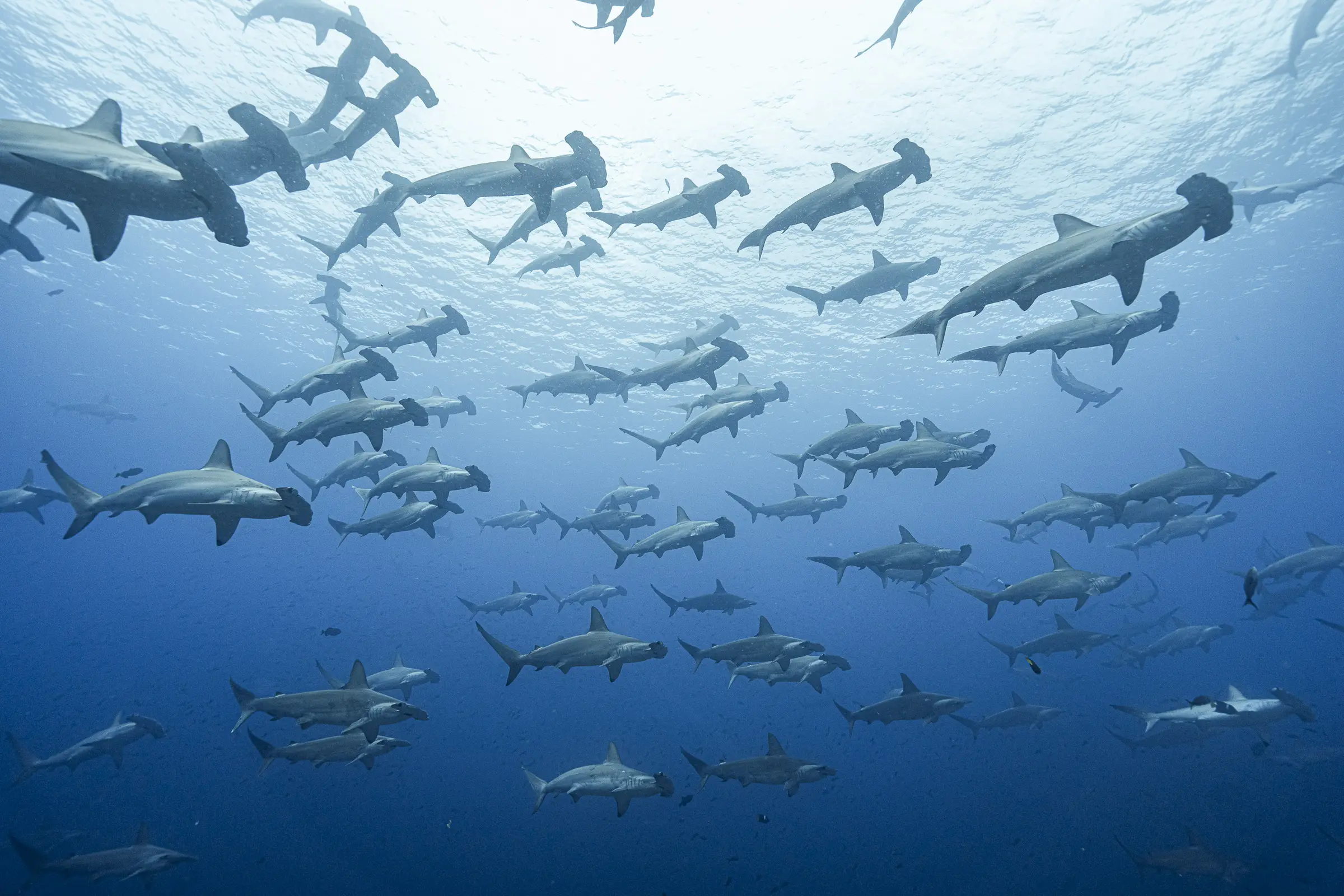
A school of scalloped hammerhead sharks seen from below against the sunlit surface

Darwin & Wolf Conservation Fund

Funding science, conservation and education to protect sharks.

Video: DWCF archive

Our mission

The Darwin and Wolf Conservation Fund (DWCF) is a US registered 501(c)(3) incorporated in 2021. We establish partnerships with local and international organizations and government agencies that share common objectives, with the mission to:

  1. Promote and help fund marine research, conservation and educational efforts globally, with a special focus in the Darwin and Wolf Islands, Galápagos Islands, Ecuador.
  2. Assist with on-the-ground efforts to help protect established Marine Protected Areas from illegal activities.
  3. Promote sustainable development and environmental awareness with the general public, with a special focus on the youth.
Two scalloped hammerhead sharks swimming in blue water
Scalloped hammerheads (Sphyrna lewini), Darwin Island.

Projects

Baited remote underwater video rig on a reef surrounded by fish

Shark applied research, conservation & policy

  • Long-term population monitoring
  • Movement & habitat use of endangered sharks
  • Fighting overfishing and IUU fishing
  • The climate crisis
A hammerhead shark swimming next to an illegal longline with baited hooks at Darwin's Arch

Helping protect MPAs from illegal activities

  • The Galápagos Marine Reserve
  • Shining a light on IUU fishing
  • The Revillagigedo National Park
  • Project lewini
Research team working on the deck of a boat in Galápagos

Sustainable development and environmental awareness

  • Tomás de Berlanga School
  • DWCF fellows

Where we work

Whale shark swimming in open blue waterGalápagos Marine Reserve, Ecuador
Manta ray just below the surface, with an island behindRevillagigedo National Park, México
School of golden cownose rays in turquoise waterIslas Marías Biosphere Reserve, México
Tiger shark swimming over a sandy seabedFrench Polynesia Shark Sanctuary

Scientific publications

Direct financial support from the DWCF has resulted in the production of 18 peer-reviewed research papers in international journals.

Selected papers (2021–2026)
  1. Mejía et al. (2026). Sustainable catches. doi:10.1016/j.rsma.2026.105004
  2. Rastoin-Laplane et al. (2026). BRUVS biogeography of the Galápagos. doi:10.1111/jbi.70196
  3. Vianna et al. (2026). Implications of longline legalization. doi:10.1016/j.marpol.2026.107106
  4. Schüler et al. (2026). Darwin & Wolf seasonal dynamics. doi:10.1016/j.ecss.2026.109710
  5. Vaudo et al. (2026). Pelagic sharks in parks: silky sharks. doi:10.1016/j.biocon.2025.111658
  6. McKinley et al. (2025). Relative abundance and diversity of sharks and predatory fishes across Marine Protected Areas of the Tropical Eastern Pacific. doi:10.1371/journal.pone.0334164
  7. Salinas de León et al. (2025). Long-distance movements of scalloped hammerhead sharks. doi:10.1007/s10641-025-01717-4
  8. Salinas de León et al. (2024). First record of a white shark in Ecuadorian waters. doi:10.1007/s10641-024-01620-4
  9. Cerutti-Pereyra et al. (2024). Vulnerability of Eastern Tropical Pacific chondrichthyan fish to climate change. doi:10.1111/gcb.17373
  10. Salinas de León et al. (2024). Longest recorded migration of a silky shark. doi:10.1111/jfb.15788
  11. Páez-Rosas et al. (2024). Assessment of nursery areas for the scalloped hammerhead shark across the Eastern Tropical Pacific using a stable isotopes approach. doi:10.3389/fmars.2023.1288770
  12. Rastoin et al. (2023). Fluctuations of Galápagos mid-water and benthic reef fish populations during the 2015–16 ENSO. doi:10.1016/j.ecss.2023.108523
  13. Mossbrucker et al. (2023). First records of two rays and three bony fishes for the Galápagos Islands. doi:10.1017/S0025315423000176
  14. McKinley et al. (2023). Functional vulnerability and biogeography of reef fish assemblages in the Galápagos Archipelago. doi:10.1016/j.ecss.2023.108301
  15. Harned et al. (2022). Genetic population dynamics of the critically endangered scalloped hammerhead shark in the Eastern Tropical Pacific. doi:10.1002/ece3.9642
  16. Moya Serrano & Salinas de León (2022). Chafing behavior by scalloped hammerhead sharks, including an unusual scratching of claspers. doi:10.1007/s12526-022-01311-2
  17. Cerutti-Pereyra et al. (2022). Ontogenetic diet changes of scalloped hammerhead sharks. doi:10.1371/journal.pone.0268736
  18. Arnés-Urgellés et al. (2021). The effects of climatic variability on the feeding ecology of the scalloped hammerhead shark in the Tropical Eastern Pacific. doi:10.3389/fmars.2021.625748

DWCF fellows

  • 2026Diego Mejía
  • 2025Franziska König
  • 2024Erika de la Cruz & Katherine Rezabala
  • 2023Eduardo Mahuad & Javier Mahuad
  • 2022Walter Pisco & Denisse Arévalo
  • 2021Jens Mayorga & Rodrigo Alvear

Board of Directors

Dr. Pelayo Salinas de León

Dr. Pelayo Salinas de León

Executive Director & Founder

Pelayo is a marine ecologist, explorer and underwater photographer with a keen interest in the creation of Marine Protected Areas, shark conservation, sustainable fishing and the communication of science. Since 2012 he has been a senior marine ecologist with the Charles Darwin Foundation for the Galápagos Islands and since 2021 affiliated faculty at Nova Southeastern University. Between 2016 and 2020 he served as Conservation Scientist for National Geographic’s Pristine Seas project, contributing to find, survey and help protect the last wild places in the ocean.

Read full bioShow less

Pelayo obtained his PhD in marine biology from Victoria University of Wellington in New Zealand in 2010. Before fulfilling his childhood dream of working in the Galápagos Islands, he was involved in several research and conservation projects in Indonesia, New Zealand and Cuba. Pelayo is based in Galápagos, where he leads several applied research projects aimed at informing the conservation of its unique marine ecosystem.

Co-author of over 80 peer-reviewed scientific publications, when he is on expedition Pelayo explores and documents the biodiversity of some of the most remote places on Earth. Recent expeditions include the Antarctic Peninsula, the Marshall Islands and Greenland.

Pelayo is also passionate about environmental awareness, underwater photography and the communication of science, and his research has been featured in a number of documentaries and magazine articles.

Mark Wong

President of the Board

President of the Fund's Board of Directors and one of its donors. His support has made possible, among other things, the research expeditions to Darwin and Wolf that underpin the monitoring programme.

Our donors

Our grantees

  • The Charles Darwin Foundation, Ecuador
  • The Guy Harvey Research Institute and Save Our Seas Foundation Shark Research Center, USA
  • IREMP, French Polynesia
  • Viva Revilla, México